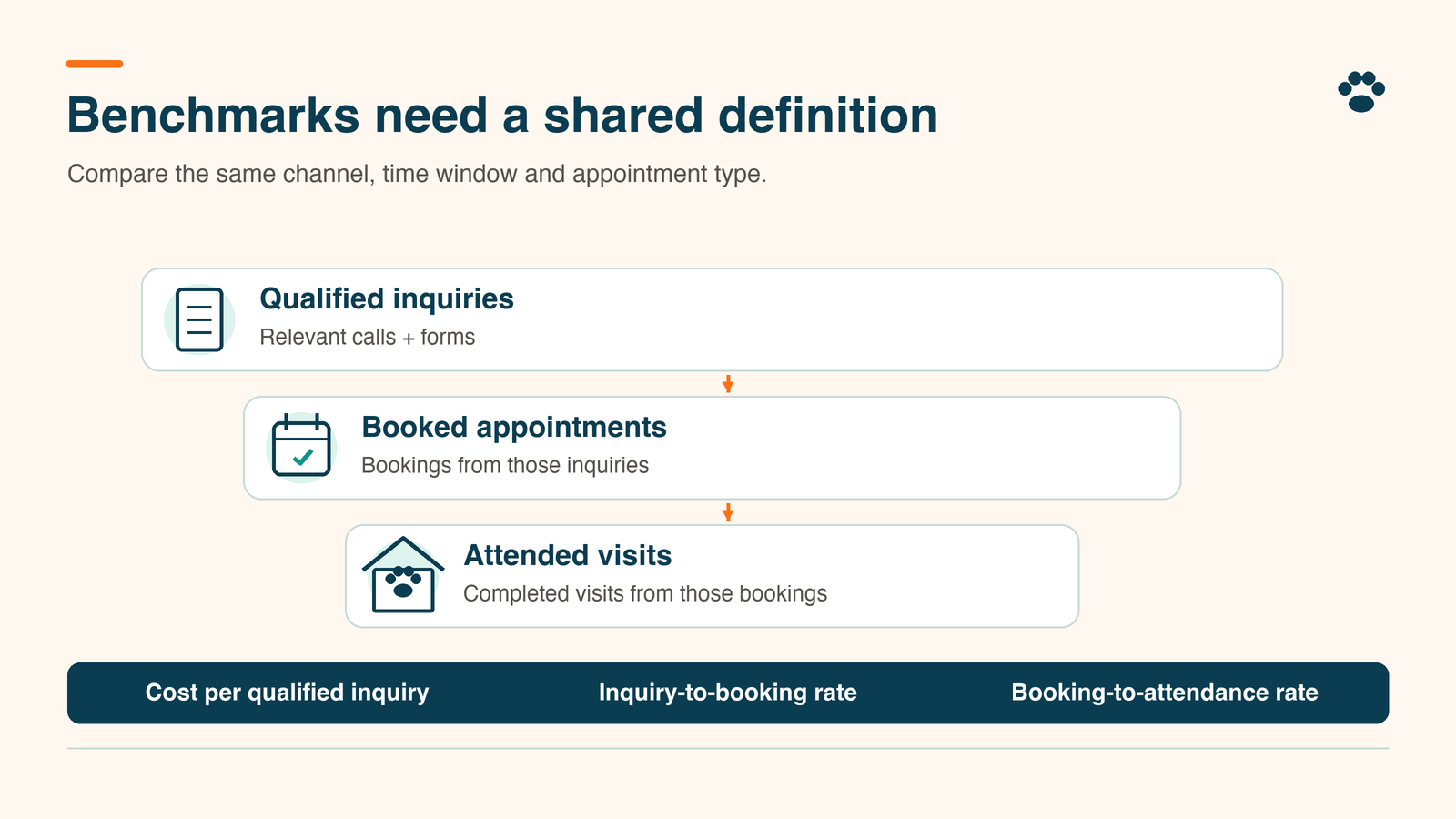
Veterinary marketing benchmarks are only as good as the definition of a lead underneath them. A phone-button tap, a repeat caller, and a confirmed new-client appointment answer three different questions, and most reports add them up as one number. When the report shows more leads and the schedule still has gaps, that definition is the first thing to check, before anyone blames the ads or the front desk.
Useful benchmarks connect spending to qualified inquiries, booked appointments, and attended visits. Define each stage, remove duplicates, and compare matching groups before judging a channel against an average. At TailWerks, that measurement lives inside the broader veterinary marketing approach, where it can be reconciled against the schedule.
Start with three rules:
- Count contact activity separately from qualified demand.
- Verify bookings and attendance against appointment records.
- Compare costs only when the service, counting rules, and time window match.
Which veterinary marketing benchmarks deserve a place on your dashboard?
Use a chain of measures that shows where demand stops moving: clicks, inquiries, qualified inquiries, bookings, and attendance. Keep new-client acquisition separate from existing-client requests. A refill question matters to the front desk; it says nothing about whether a campaign brought in a new household.
Decide what one unit of growth is before reporting results. A household, an individual pet owner, a patient, and an appointment are four different things. For this worksheet, inquiry measures count one deduplicated prospective client (one new household, counted once) and scheduling measures count one appointment ID. Track new patients separately if that is your growth goal.
A family booking two pets creates two appointments and one new client. Decide which outcome the dashboard measures, and write it down, so the larger number never wins by default.
Build a metric-definition worksheet
Write the counting rule beside every number. Use this worksheet with your practice manager and marketing partner before setting targets. These are proposed reporting definitions for your clinic; no industry body has standardized them.
| Measure | Counting rule | Evidence and exclusions |
|---|---|---|
| Inquiry activity | Count calls, submitted forms, and messages as separate contact events. | Use contact logs. Separate spam, existing-client requests and repeat attempts. A phone-button click is click activity; a connected call is a different line. |
| Qualified inquiry | Count one prospective client with a real request for a service, species and location your clinic accepts, within a documented deduplication window. | Review contact outcomes. Exclude vendors, job seekers and unsuitable requests. Record unavailable appointments on their own line instead of calling them poor-quality demand. |
| Booked appointment | Count one confirmed appointment ID linked to the campaign or channel being reviewed. | Verify the scheduling record. Exclude requests awaiting confirmation. Keep the original booking when a visit is rescheduled, so one reschedule still counts as one booking. |
| Attended appointment | Count one appointment from that booked group with a verified attended or completed status. | Check the practice management system. Keep cancellations, no-shows and future visits separate. |
| Cost per booked appointment | Divide the stated acquisition cost by confirmed bookings attributed under the stated reporting rule. | Match channel, location and cost scope. Label media-only cost separately from cost including management and tracking. |
| Cost per attended appointment | Divide that group’s acquisition cost by its verified attended appointments. | Use a group with enough follow-up time. Report unresolved future visits as pending instead of counting them as no-shows. |
Add the reporting period, deduplication window, record owner, and last reconciliation date above the worksheet. Keep identifiable client information in approved clinic systems and out of the shared marketing summary.
How do you calculate booking and attendance performance?
Cost per booked appointment equals acquisition cost divided by attributed confirmed bookings. Cost per attended appointment uses attended appointments from the same group, meaning the same campaign, channel, and period. Neither formula tells you profitability without service costs and revenue.
Choose the numerator deliberately. Media-only cost helps evaluate ad buying. Media plus management, tracking, and allocated production costs answers a broader acquisition-cost question. Do not compare one channel’s fully loaded cost with another channel’s media bill.
The chain for one campaign in one month, with illustrative numbers:
| Stage | Count |
|---|---|
| Media spend | $2,400 |
| Management and tracking | $900 |
| Clicks | 410 |
| Contact events (calls, forms, messages) | 96 |
| Qualified new-client inquiries, deduplicated | 38 |
| Confirmed bookings | 21 |
| Bookings with a visit date already passed | 19 |
| Attended | 17 |
Cost per booked appointment is $114 on media alone ($2,400 ÷ 21) and $157 fully loaded ($3,300 ÷ 21). Cost per attended appointment is $141 on media and $194 fully loaded, dividing by the 17 attended visits. Inquiry-to-booking is 21 of 38, or 55%. Attendance is 17 of 19, or 89%: two no-shows, plus two more visits still in the future and reported as pending. The 96 contact events never appear in a cost figure. They are the number the old report called leads.
For inquiry-to-booking performance, divide qualified prospective clients who booked by qualified prospective clients in the same group. That is a client-level rate. Dividing appointment IDs by people creates a different measure and can exceed 100% when someone books multiple pets.
For attendance, divide attended appointments by booked appointments whose visit dates have passed, using a stated cutoff. Explain how rescheduled appointments move between reporting periods. If a denominator is zero, report the measure as not calculable; a zero cost would be wrong.
Use the veterinary Google Ads budget calculator to test your own inputs. Its preloaded assumptions are placeholders, never a clinic target.
What Google Ads and GA4 are counting
Read the configured action before interpreting a conversion total. Google Ads lets you set each conversion action to count Every conversion after an ad interaction or One per ad click, and Google’s own setup guidance recommends One for leads and Every for sales. Even on One, the count is per click and per conversion action, so a pet owner who clicks twice, or calls and then submits a form, can appear twice. It is a per-click deduplication, and a long way from a clinic-wide register of unique people.
Google Analytics 4 treats every measured interaction as an event. Marking one as a key event flags its business importance; it verifies nothing about the appointment. A booking-button key event proves the configured event fired. Whether the practice accepted the visit is a question for the schedule. The same event imported into Google Ads is reported there as a conversion, so the two reports carry different names and, often, different totals for one action.
Audit the labels in your report. Keep phone clicks, connected calls, qualified inquiries, and confirmed bookings on separate lines. Test a real booking path and reconcile its outcome before relying on an event named book appointment.
GA4’s attribution settings govern how credit is assigned: the reporting attribution model, the channels eligible to receive credit for conversions shared with Google Ads, and the lookback window. Changing the model rewrites historical reports; changing the lookback window applies only going forward. Treat attributed bookings as a reporting view. It does not follow that every credited appointment would disappear without advertising.
When are channel and location comparisons fair?
Compare like with like, then investigate differences. Separate branded search from non-branded search, general practice from urgent care, and new clients from returning clients. Record appointment availability alongside costs so a closed schedule is visible in the diagnosis.
Use one clinic-wide reconciliation rule for paid search, organic search, and traditional advertising. Dedicated tracking paths or a recorded referral answer can provide source evidence; label unresolved sources unknown. Do not force an uncertain phone inquiry into the channel that needs a better month.
Keep platform attribution reports separate from the deduplicated clinic total. If several reports claim credit for the same appointment, adding their totals counts reporting claims, and the clinic still got one visit.
Before accepting a published benchmark, check its date, geography, practice type, sample, cost scope, and definition of success. A cost per form submission cannot establish a good cost per attended new-client appointment. Without comparable evidence, use your own consistently measured history as the baseline.
Our Take
A benchmark earns its place when it changes a decision. A cheaper inquiry is only progress if more suitable pet owners reach the schedule. In the same way, a weak booking rate does not establish that reception needs training. Check availability, requested services, missed connections, and follow-up first.
Review the chain in order. If qualification falls, inspect targeting and service-page clarity. Qualified demand holding while bookings fall points to appointment access and contact handling. Bookings holding while attendance falls points to the cancellation and reminder workflow. These are diagnostic starting points, and the records decide the rest.
Put one finding, one owner and one next test on the monthly dashboard. At TailWerks we expect anyone proposing paid advertising management, us included, to explain how their report will tell those problems apart before recommending more spend.
Frequently Asked Questions
What is a good cost per booked veterinary appointment?
Set a clinic-specific threshold using service economics, available capacity, and consistently defined acquisition costs. Compare it with your own history before applying an external range built on a different definition.
Should every veterinary phone call count as a lead?
No. Count calls as contact activity first. Classify real prospective-client requests separately from existing-client questions, repeat attempts, spam, and unsuitable requests.
Can GA4 tell us which clients attended?
Not from website events alone. Attendance needs verified clinic records and a deliberate reporting connection. When you cannot reconcile it, report attendance as unknown; inferring a visit from a website action is a guess.
Should this month’s ad spend be divided by this month’s visits?
That divides this month’s money by visits that last month’s ads may have produced. If you use it, label it a calendar-period operational ratio. For acquisition analysis, follow the attributed booking group long enough to observe its appointment outcomes.
Find the gap between the report and the schedule
Bring your veterinary marketing benchmarks, recent contact outcomes and appointment totals, and schedule a Search-to-Schedule Audit with TailWerks. We will work through the definitions, the tracking gaps, and the point where qualified demand stops becoming attended visits, so you know what needs checking before you increase the budget.