Your marketing report shows more clicks. Your practice manager sees open appointments, callers asking for services you do not offer, or new-client requests arriving when nobody can answer. Before replacing the agency, figure out which of those problems you have.
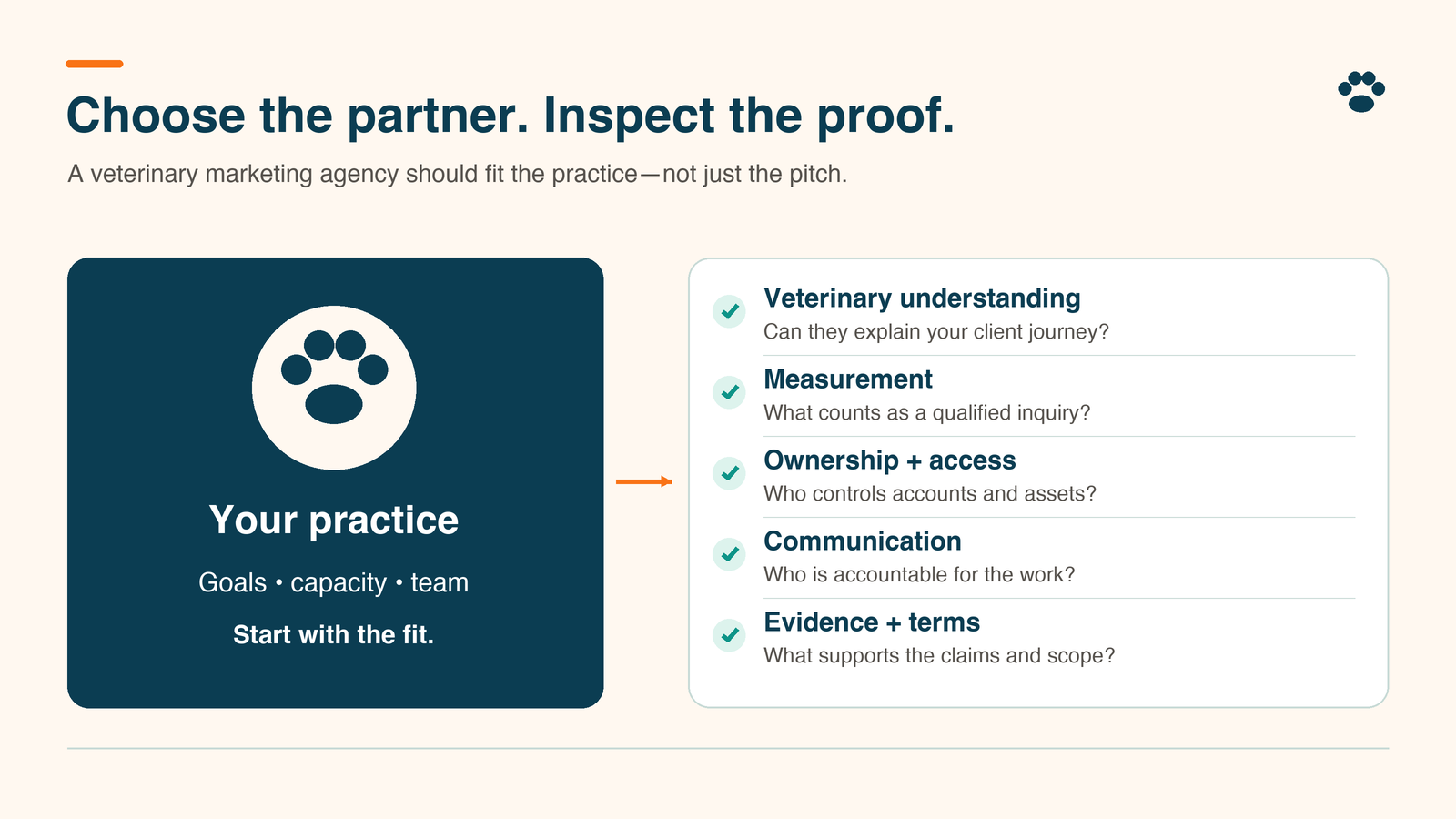
To choose a veterinary marketing agency, compare its diagnosis, account access, appointment reporting, written scope, and exit plan. Ask every candidate for evidence against the same list of requirements.
We are an agency. TailWerks provides veterinary marketing services, so we have a commercial stake in this decision. Apply the checks below to us too. This is a diligence process, not a ranking with our name conveniently at the top.
- Name the failure before buying the replacement.
- Verify access with your own login.
- Separate clicks, inquiries, booked appointments, and attended visits.
- Agree on what transfers before agreeing on what starts.
Define what needs to change
Write one sentence describing the business problem.
Example: We need more new-patient wellness appointments on weekdays. That gives an agency something to investigate.
Too vague: Our marketing feels stale. That leaves them guessing.
Then inspect the path. Are local pet owners finding the practice for relevant services? Do they reach the right page? When they call, does someone answer? And can the clinic accept the appointments being promoted?
Ask the current agency for its diagnosis, supporting records, and proposed correction. Next, give candidates the same facts and ask what evidence would change their recommendation. A recommendation to rebuild everything needs more support than a recommendation to fix one broken form.
Clinic readiness- the things to fix on your side first- is covered in our checks to complete before hiring an agency. This article is about the partner: whether they can identify the constraint and own the agreed work.
How do you choose a veterinary marketing agency using evidence?
Use the same interview scorecard for every candidate. Our suggested scoring is deliberately basic: zero for unanswered, one for a verbal explanation, two for written terms or a demonstrated process. It measures how complete the evidence is, and nothing more.
| Area | Interview prompt | Evidence to request |
|---|---|---|
| Diagnosis | Explain what you inspect before recommending spend. | Ordered investigation tied to our service capacity |
| Account control | Show the access our clinic retains. | Account inventory and demonstrated clinic login |
| Appointment reporting | Distinguish an inquiry from a booking. | Sample definitions, report, and reconciliation method |
| Scope | Assign pages, ads, tracking, and approvals. | Deliverables, exclusions, responsibilities, and cadence |
| Fees | Itemize costs outside the management fee. | Setup, media, software, usage, and renewal charges |
| Data export | Specify what we take and in what format. | Sample export, retention terms, and delivery deadline |
| Website and creative | Identify what is owned, licensed, or rented. | Written rights and a usable handoff specification |
| Transition | Explain what stays live during the switch. | Named owners, cutover checklist, and fallback plan |
Record the document or demonstration behind each score. Still, a strong total does not cancel an unresolved critical item. If clinic account access is missing, appointment definitions are unclear, or the exit process is undocumented, have another conversation before you sign.
Veterinary specialization belongs in the interview too. Ask how the agency handles urgent versus routine inquiries, clinical approvals, unavailable services, and appointment capacity. A relevant answer describes a workflow with named steps and owners.
Appointment reporting needs agreed definitions
Ask for a report that follows the Search-to-Schedule path, our term for every step between a pet owner’s search and a visit on the schedule: inquiry, qualified inquiry, booked appointment, and attended visit. Then define a qualified inquiry around the clinic’s services, geography, and availability. Keep appointment requests separate from confirmed bookings.
Require the agency to explain where each field comes from, who updates it, and what remains unknown. If your practice-management system cannot supply booking outcomes, agree on a limited reconciliation process with staff. Do not accept a software integration promise without a test on your own setup.
For paid search, request separate views of media spend and total marketing cost. Ask which cost the agency uses when discussing appointment acquisition. Our article on veterinary PPC management covers the campaign-side questions. It does not replace clinic booking records, though.
Google’s third-party transparency requirements cover advertising cost and performance disclosure, including separating Google’s charges from agency fees. Appointment reporting is a separate business requirement, so it belongs in your scope. An agency can be fully compliant with Google and still hand you an incomplete clinic report.
Who controls the accounts, website, and creative?
Check access before notice goes out. Keep clinic-controlled administrative access to every core marketing account and document the agency’s permissions separately. Google Ads access documentation explains how to inspect and change user access. Log in yourself. A screenshot proves nothing.
Account ownership has a specific meaning in Google Ads. An owner manager account receives elevated permissions, but Google says the client account retains its data and administrative rights. Its client-account ownership guidance also explains that linking an existing account does not automatically grant manager ownership. Before granting them, ask whether the agency needs those elevated privileges at all.
For Google Business Profile, our preference is clinic-held primary ownership with agency access suited to the work. Google’s owner and manager documentation distinguishes those roles and supports individual Google Accounts instead of shared passwords.
Extend the inventory beyond Google: domain registration, hosting, website administration, analytics, tags, call tracking, booking links, and creative files. Put ownership and licensing terms in writing. An export of your website and a website another provider can run are two different deliverables. Ask for the second one.
Put fees and scope in writing
Compare the same work over the same period. Separate management fees, advertising spend, setup, hosting, software, communication usage, integrations, and optional production. Also ask who can approve extra charges and how changes are documented.
Google’s third-party policies require separate accounts for separate end-advertisers. Its transparency rules also require advance disclosure of management fees. Those are platform requirements. Your service agreement still has to cover everything else.
Specify what the clinic supplies: current service information, clinical review, usable photos, approval turnaround, and booking feedback. Then read renewal, cancellation, export, and transition provisions. A monthly invoice does not establish a month-to-month commitment.
Protect inquiry paths during the switch
Build a handoff schedule before removing access. Assign an owner and acceptance test to the domain, website, campaigns, billing, tracking numbers, forms, appointment links, and reporting exports. Confirm what data can transfer and what depends on a provider’s software or license.
Save a reporting baseline, then test calls, forms, and booking links before and after cutover, including where each inquiry lands with staff. Know who can restore the previous setup if something critical breaks.
Google’s unlinking instructions include a preview of affected accounts. Review that impact before confirming removal. Removing access belongs near the end of a verified transition, not at the beginning of a disagreement.
Our Take
Choose the agency that makes its work inspectable. A compelling diagnosis matters, but it needs an account you can access, definitions your team understands, and terms that survive a change of provider.
At TailWerks, we would rather see a clinic keep its current partner with a specific correction plan than switch into the same measurement gap. Change partners when the evidence shows the work, access, or accountability cannot meet the agreed standard. Change the process when the process is the problem.
A new agency cannot fix an undefined agreement by inheriting it.
Frequently Asked Questions
Does a veterinary clinic need a specialist agency?
Not automatically. Ask any candidate to demonstrate how its work handles service intent, appointment capacity, clinical approvals, and staff handoffs. Specialization is useful when it changes decisions, not merely the proposal cover.
What if the agency cannot track booked appointments yet?
Require a documented limitation and a practical measurement plan. Agree who supplies booking outcomes, how records are matched, and how uncertainty appears in reports. Label inquiries as inquiries until bookings can be verified.
Must we rebuild the website when switching agencies?
Decide after checking access, rights, technical condition, and appointment paths. Ask for a repair option alongside any rebuild recommendation, and propose and explain what a replacement solves that targeted fixes cannot.
What should the outgoing agency hand over?
Use the agreement and asset inventory to specify account access, deliverable files, permitted exports, licenses, reporting history, and transition responsibilities. Put formats and deadlines in writing so cooperation is a deliverable with a date.
Check the problem before choosing the partner
Before you choose a veterinary marketing agency, bring the evidence together: recent reports, service priorities, appointment capacity, account access, and current terms.
Schedule a Search-to-Schedule Audit with TailWerks. We will look at where pet owners find you, where inquiries drop off, and which website, tracking, or booking issue needs attention next. Bring the scorecard. Use it on us.